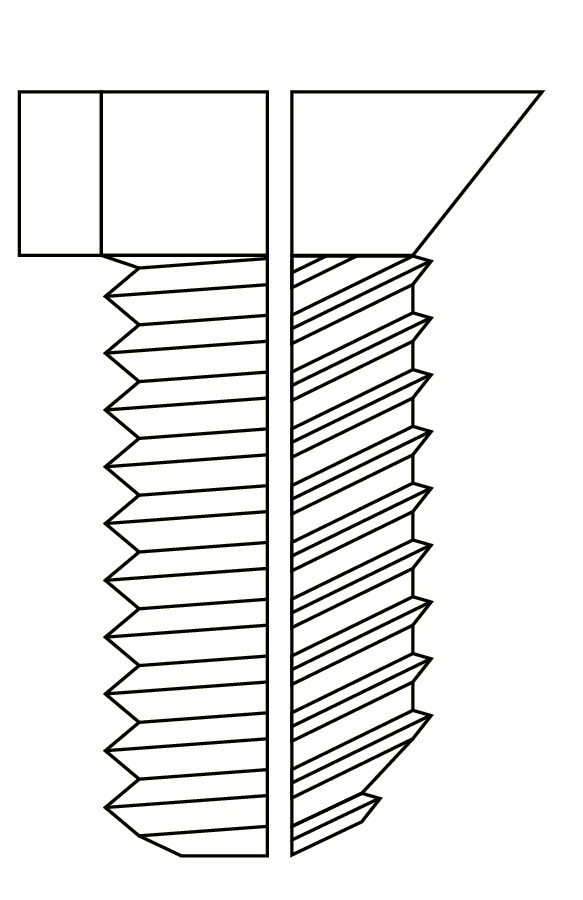
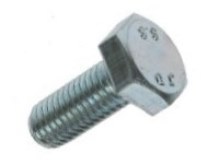
Hex Head Setscrew DIN 933
The DIN 933 hex head setscrew is a fully threaded bolt used widely in structural, mechanical, and general engineering assemblies. We stock setscrews from M4 to M48 in high tensile steel (grades 8.8, 10.9 and 12.9) and stainless steel (A2 and A4 in grades 50, 70 and 80). Setscrews can also be specially manufactured in any material to order.
We supply hex setscrews in the following materials:
| Steel grades | 8.8, 10.9 & 12.9 | |
| Stainless Steels | A2 Grades 50, 70 & 80 | A4 Grades 50, 70 & 80 |
Dimensions for DIN933 Hex Head Setscrew
| Diameter | Pitch | Head Depth | Across Flats |
|---|---|---|---|
| M4 | 0.7mm | 2.8mm | 7mm |
| M5 | 0.8mm | 3.5mm | 8mm |
| M6 | 1.0mm | 4mm | 10mm |
| M7 | 1.0mm | 4.8mm | 11mm |
| M8 | 1.25mm | 5.3mm | 13mm |
| M10 | 1.5mm | 6.4mm | 17mm |
| M12 | 1.75mm | 7.5mm | 19mm |
| M14 | 2mm | 8.8mm | 22mm |
| M16 | 2mm | 10mm | 24mm |
| M18 | 2.5mm | 11.5mm | 27mm |
| M20 | 2.5mm | 12.5mm | 30mm |
| M22 | 2.5mm | 14mm | 32mm |
| M24 | 3.0mm | 15mm | 36mm |
| M27 | 3.0mm | 15mm | 41mm |
| M30 | 3.5mm | 18.7mm | 46mm |
| M33 | 3.5mm | 21mm | 50mm |
| M36 | 4mm | 22.5mm | 55mm |
| M39 | 4mm | 25mm | 60mm |
| M42 | 4.5mm | 26mm | 65mm |
| M45 | 4.5mm | 28mm | 70mm |
| M48 | 5mm | 30mm | 75mm |
What is the difference between a setscrew and a bolt?
A DIN 933 setscrew is fully threaded along the entire shank length, whereas a bolt (DIN 931) has a plain, unthreaded portion below the head. Setscrews are generally preferred where the full thread engagement is needed through the assembly, while bolts suit applications where a clearance hole is used and clamping force is applied under the head.
Which grade of setscrew should I use for outdoor or corrosive environments?
For outdoor or mildly corrosive environments, A2 stainless steel (304 grade) setscrews are suitable for most applications. For marine, chemical, or high-chloride environments, A4 stainless steel (316 grade) provides better resistance. Zinc-plated high tensile setscrews offer some protection but are not recommended for prolonged exposure to moisture.
What do the steel grades 8.8, 10.9, and 12.9 mean?
The first number represents the ultimate tensile strength divided by 100 (e.g., 8.8 = 800 N/mm²), and the second number is the ratio of yield strength to tensile strength. Grade 8.8 is the standard for general engineering use. Grades 10.9 and 12.9 are used in higher-stress applications such as engine assemblies, structural steelwork, and heavy plant, where greater clamping force is required from a given bolt size.